en

Need Help Now? Call Us!
+86-159 9623 5291

Our team proudly offers an on-time guarantee and a 100% customer satisfaction guarantee.
Contact Online


 Home / News / Industry News / Monoblock vs Sectional Directional Valves: Modular Expansion and Pressure Drop
 2026.11.04
 Industry News
Content
Directional control valves route hydraulic fluid to actuators, motors, and lifts in mobile and industrial machinery. For engineers selecting a monoblock vs sectional directional control valve, modular expansion and pressure drop analysis are the two most important design considerations. Both designs are common in agricultural machinery, construction equipment, and mobile hydraulic systems. The right option depends on the number of functions, flow requirements, installation constraints, and expected machine variants.
Choose a monoblock valve when the circuit is fixed. Choose a sectional valve when modular expansion is part of the machine plan.
A monoblock directional control valve uses a one-piece body, usually cast iron or aluminum, with multiple spools housed in a single block. Internal passageways connect the inlet, tank, and work ports, while spools direct flow to different actuator functions.
Because the body is cast and machined as a single unit, a monoblock valve has fewer external joints and seals. The internal flow paths can be kept short and direct, which reduces leakage risk and can reduce pressure drop at moderate flow rates.
The main limitation is design flexibility. The number of spools is fixed at production. If the machine later needs an additional hydraulic function, the monoblock valve normally cannot be expanded. The installer must replace the valve and modify the plumbing, creating extra cost and downtime.
A sectional directional control valve is assembled from individual spool sections stacked together and secured with tie rods or mounting hardware. Each section contains one spool and its work ports. An inlet cover, outlet cover, and relief components complete the assembly.
This stacked construction is the basis of modular expansion. Sections can be added, removed, or replaced within the manufacturer’s allowed bank size, allowing a valve bank to grow with the machine’s hydraulic requirements. Sectional valves are widely used when a machine has multiple functions such as loader lift, tilt, auxiliary implements, and steering circuits.
The stacked design creates additional joints and internal transition passages. Every interface between sections introduces another potential leak path and increases flow path complexity. As a result, pressure drop can be higher than a comparable monoblock valve, especially when the bank is long or the internal gallery is undersized for the total flow.
When a machine’s hydraulic functions change over time, modular expansion is often the deciding factor. A monoblock valve is essentially frozen at its original configuration. Adding a spool means designing and ordering a new body with more stations, then reworking inlet and outlet connections. For a machine already in production, that change is expensive.
A sectional valve is better positioned for future expansion. To add a hydraulic function, a designer selects a compatible section, bolts it into the stack, and connects the additional work ports. This is why many agricultural and mobile equipment manufacturers choose sectional valve banks for machines with evolving tool requirements.
Of course, modular expansion has limits. Each valve model has a maximum number of sections based on tie-rod length, inlet flow capacity, and structural rigidity. The design must confirm that the inlet cover can supply enough flow and that the pressure rating remains valid after adding sections. A sectional valve also needs careful selection of spool capabilities, detent mechanisms, and relief valves to match the new function.
Pressure drop is the pressure loss that occurs as hydraulic oil flows through the valve. It is caused by friction, turbulence, sudden changes in passage direction, and restrictions formed by spool lands or orifices. A higher pressure drop means more energy converted into heat, lower efficiency, and possibly reduced actuator speed or force.
For monoblock valves, the one-piece body allows internal passages to be machined with fewer abrupt turns. The flow path from inlet to outlet can be comparatively short, which often produces a lower pressure drop at the same flow rate. This is useful in systems that run continuously or at high flow.
Sectional valves present a different hydraulic path. Oil enters the inlet cover, travels through internal galleries in the stack, passes through the selected spool sections, and exits through the outlet cover. Each section joint and each transfer between sections can add resistance. The actual pressure drop depends on the number of sections, the size of the internal gallery, spool design, and the flow rate.
When a machine is sensitive to energy loss, the pressure drop analysis should be done on the complete valve bank, including inlet and outlet covers, relief valves, and any transition plates. A sectional valve with an oversized gallery may perform as well as a monoblock valve, while an undersized sectional bank can cause noticeable heat generation and sluggish operation.
| Feature | Monoblock Valve | Sectional Valve |
|---|---|---|
| Body construction | One-piece cast or machined body | Stacked spool sections with tie rods |
| Modular expansion | Limited; new valve required to add spools | High; sections can be added or removed |
| Pressure drop | Often lower due to short internal flow paths | Can be higher due to inter-section galleries |
| Leak points | Fewer external seals and joints | More joints between stack sections |
| Configuration flexibility | Fixed at time of order | Configurable by spool, port, and control type |
| Service | Simpler body, whole-valve repair | Section-level replacement is faster but requires more seals |
| Typical use | Stable machine architectures, lower cost | Highly variable machines, future expansion |
The decision starts with the machine’s current hydraulic functions and likely future changes. If the machine architecture is fixed and the number of spools will not change, a monoblock valve offers a compact and economical solution. If the machine must support different attachments, multiple model variants, or staged upgrades, a sectional valve provides the modularity needed to avoid costly redesigns.
Also consider pressure and flow data. Compare the pressure drop across the valve bank at maximum flow. A monoblock valve may be more efficient in a simple circuit, while a sectional valve can be optimized by selecting larger internal galleries and fewer restrictive spool features. The supplier’s technical data should state the operating pressure, rated flow, and pressure drop curves.
For solenoid-operated directional control, the PDCF50 series four-way solenoid control directional valve is a representative option to evaluate.
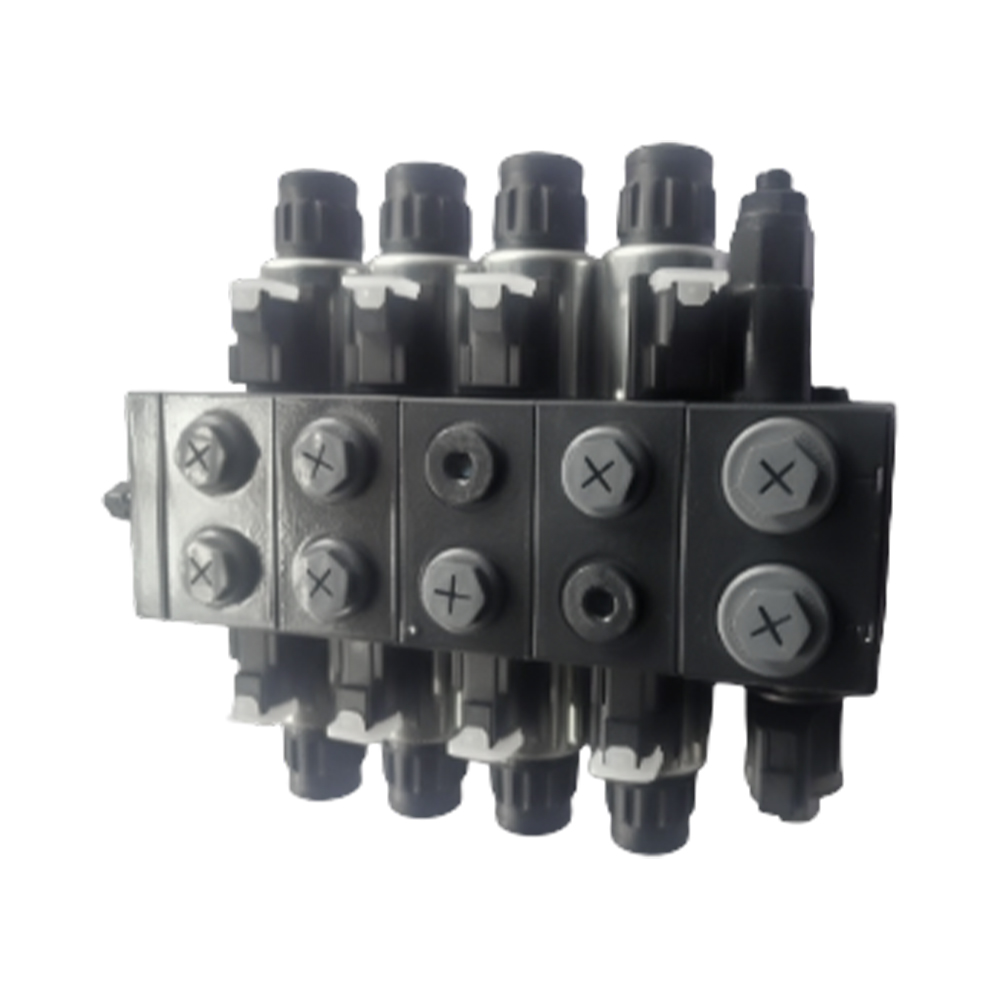 PDCF50 Four-Way Solenoid Directional Control ValveThis electromagnetically controlled modular valve suits complex motion control in hydraulic systems. Its durable cast body, relief valve, and sealed coil support reliable performance in demanding applications like construction and agricultural equipment.View Product →
Before finalizing, review the full performance data in our guide on how to select the right directional control valve for hydraulic systems. Also consider spool actuation: manual lever, solenoid, hydraulic pilot, or pneumatic pilot.
In real machine designs, the valve choice depends on how the operator uses the equipment. A tractor with a rear lift, front loader, and several remote valves may need a sectional bank that can be expanded as implements change. A combine harvester or grain cart often benefits from a compact, fixed-function valve with low pressure drop.
For agricultural machinery, Anhui Zhongjia Hydraulic Technology Co., Ltd. offers both manually controlled and solenoid-operated directional valves. The 2-way manual valve designed for corn and wheat applications is a suitable example of a simple, function-specific control element for harvesting equipment.
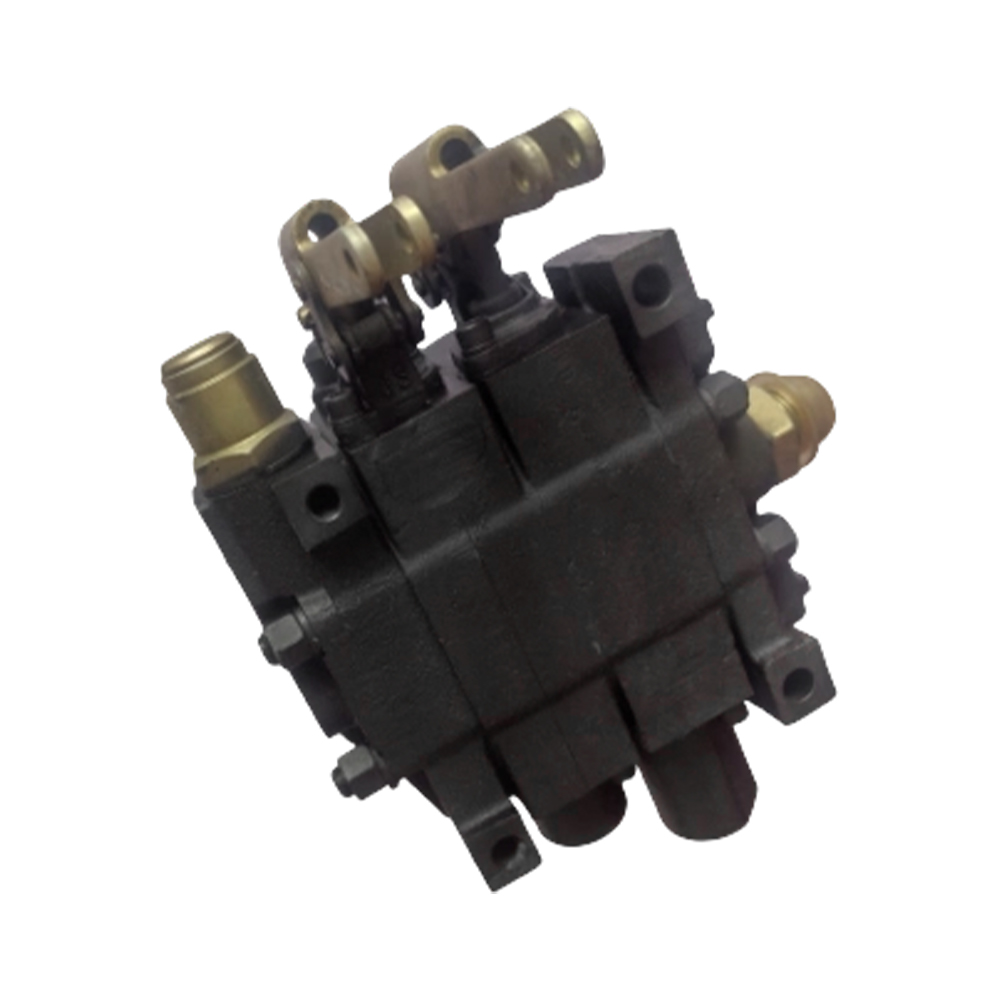 Two-Way Manual Valve for Corn and Wheat HandlingThis compact manual valve is designed for grain processing lines, enabling smooth switching and precise diversion of corn or wheat flow. Its wear-resistant body and simple operation suit flour mills, feed mills, and silo conveyor systems.View Product →
For tractor systems, a dedicated hydraulic solenoid valve for large-and-medium tractor lift can provide stable electro-hydraulic control of the three-point hitch, reducing operator effort while maintaining precise position.
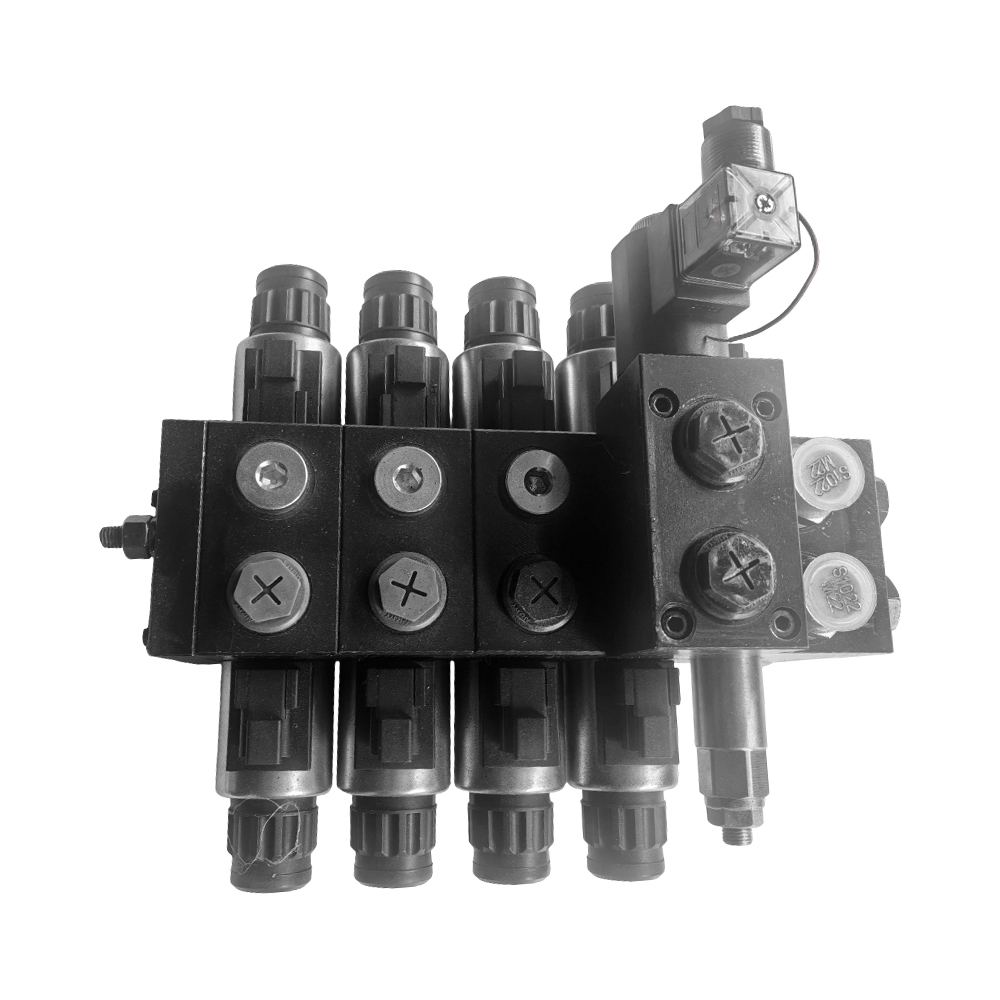 Hydraulic Solenoid Valve for Large and Medium Tractor LiftThis electrically controlled directional valve provides precise response for lifting, lowering, and floating of tractor implements. Its alloy steel body and sealed design handle heavy-duty agricultural tasks, improving efficiency in tillage, sowing, and harvesting operations.View Product →
The important point is to evaluate the valve body together with circuit layout, pressure drop, and future expansion needs, rather than comparing monoblock and sectional valves only on initial purchase price.
In a like-for-like comparison, a monoblock valve often has a lower pressure drop because the fluid path is shorter and contains fewer inter-section galleries. However, a sectional valve with a generously sized internal gallery can match or exceed the efficiency of a monoblock valve at moderate flow rates. Always compare pressure-drop curves at your operating flow and oil viscosity.
No. The spool count and internal passages are fixed during manufacturing. If future modular expansion is likely, select a sectional valve from the beginning so the existing bank can be modified rather than replaced.
Monoblock and sectional directional control valves both have a place in modern hydraulic systems. The monoblock design wins when simplicity, compactness, and lower initial cost are the priorities. The sectional design wins when modular expansion, configuration flexibility, and serviceability matter more.
Pressure drop analysis must be part of every comparison. Ask the valve manufacturer for pressure drop data at your expected flow rate, oil viscosity, and temperature. Then consider how the valve bank will be mounted, how many functions the machine needs now, and how many it may need in five years.
If you are still deciding between the two architectures, our article on which directional control valve you need can help you match circuit requirements to the right valve family.
Recommended Products

Contact Info.
+86-159 9623 5291
No. 5, Chuangye Road, Niandou Industrial Park, Ma'anshan City, Anhui Province, China
MOBILE QR CODE

 English
 Español