en

Need Help Now? Call Us!
+86-159 9623 5291

Our team proudly offers an on-time guarantee and a 100% customer satisfaction guarantee.
Contact Online


 Home / News / Industry News / Construction Machinery Brake Caliper: Definition, Types, Selection and Maintenance
  2026.09.04
  Industry News
 Content
On an active demolition site, a 20-tonne wheel loader performs more than 60 braking events per hour. At every stop, the construction machinery brake caliper must convert high-pressure hydraulic oil into a clamping force that can reliably decelerate a machine operating near its full mass. Unlike a passenger car caliper, this component has to survive vibration, dust, water splash, and frequent emergency stops. This article explains exactly what a construction machinery brake caliper is, how it works, which types exist, and what engineers and buyers should verify before selecting one.
Core definition: A construction machinery brake caliper is a hydraulic actuator that presses brake pads against a rotating disc. It receives pressurized fluid from the brake master cylinder and uses one or more pistons to generate the friction force needed to stop or hold a machine.
A construction machinery brake caliper is the final hydraulic element that converts brake pressure into braking torque. In a disc brake system, the caliper body is mounted on the axle or steering knuckle. It houses the brake pads, one or more hydraulic pistons, sliding pins or guide bolts, seals, and a bleeding screw. When the operator presses the brake pedal, hydraulic fluid at up to 20 MPa enters the caliper cylinders and pushes the pistons out. The pistons press the inner and outer brake pads against the steel disc rotor, creating friction that slows the machine.
Construction machinery calipers are not scaled-up automotive parts. The working environment includes mud, concrete dust, high ambient temperatures, and shock loads from uneven ground. Therefore, the caliper body is often cast iron or forged steel, the seals are high-temperature NBR or HNBR, and the mounting structure is reinforced to resist constant shock. Anhui Zhongjia Hydraulic Technology Co., Ltd. manufactures construction machinery brake calipers specifically for these conditions.
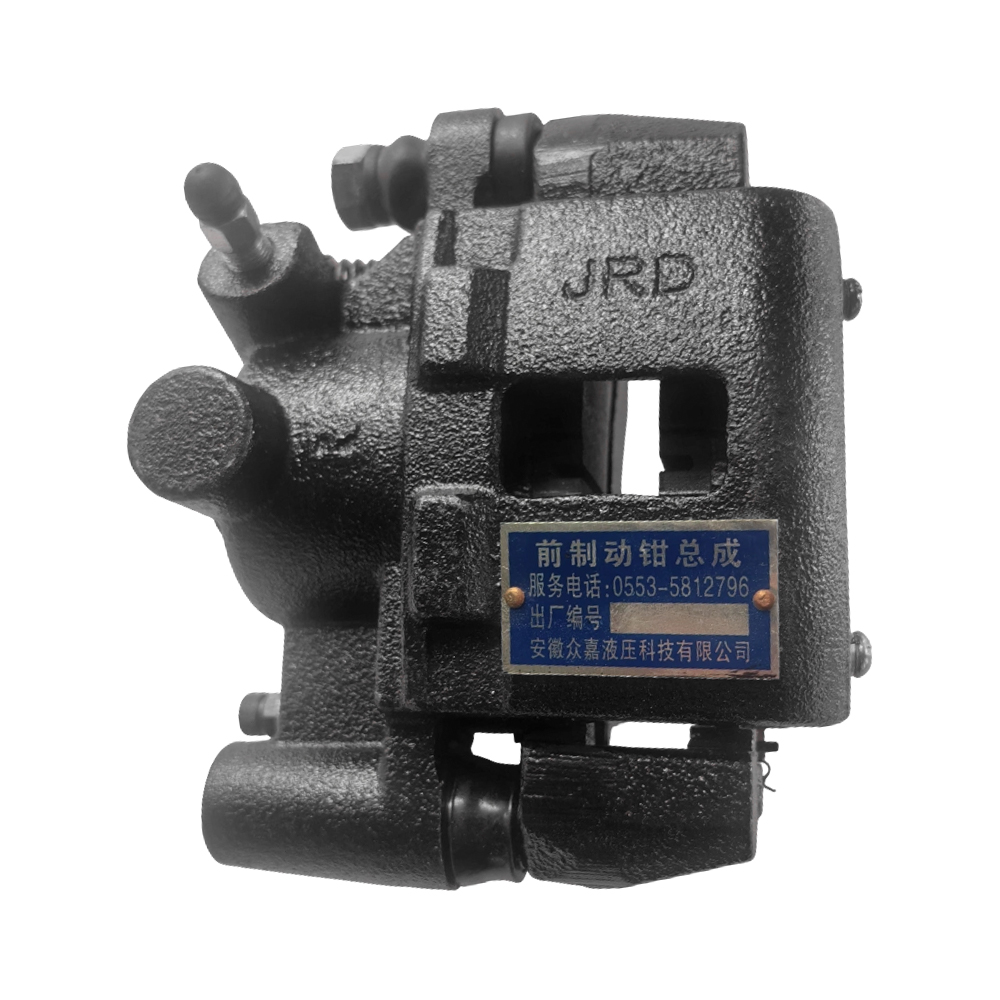
 Heavy-Duty Construction Machinery Brake Caliper for Harsh EnvironmentsEngineered for loaders, excavators, and forklifts, this cast-steel caliper delivers reliable braking and parking in mining and construction sites. Its reinforced piston and multi-seal design resist mud, water, and dust, ensuring long-term durability under shock loads.View Product →
Why it matters: The caliper is the only component in the brake system that physically touches the moving part. If the caliper leaks, seizes or mounts incorrectly, the entire braking capacity of the machine is compromised, even if the master cylinder and hydraulic lines are working perfectly.
When hydraulic pressure enters the caliper cylinder, the piston applies a force equal to the pressure multiplied by the piston area. This is a direct application of Pascal's law. An 80 mm bore piston with 15 MPa of pressure creates approximately 75 kN of clamping force. That force is multiplied by the friction coefficient of the brake pad (typically 0.35-0.45) and the effective radius of the brake disc to produce the braking torque. The caliper geometry determines how evenly this force is applied across the pad surface.
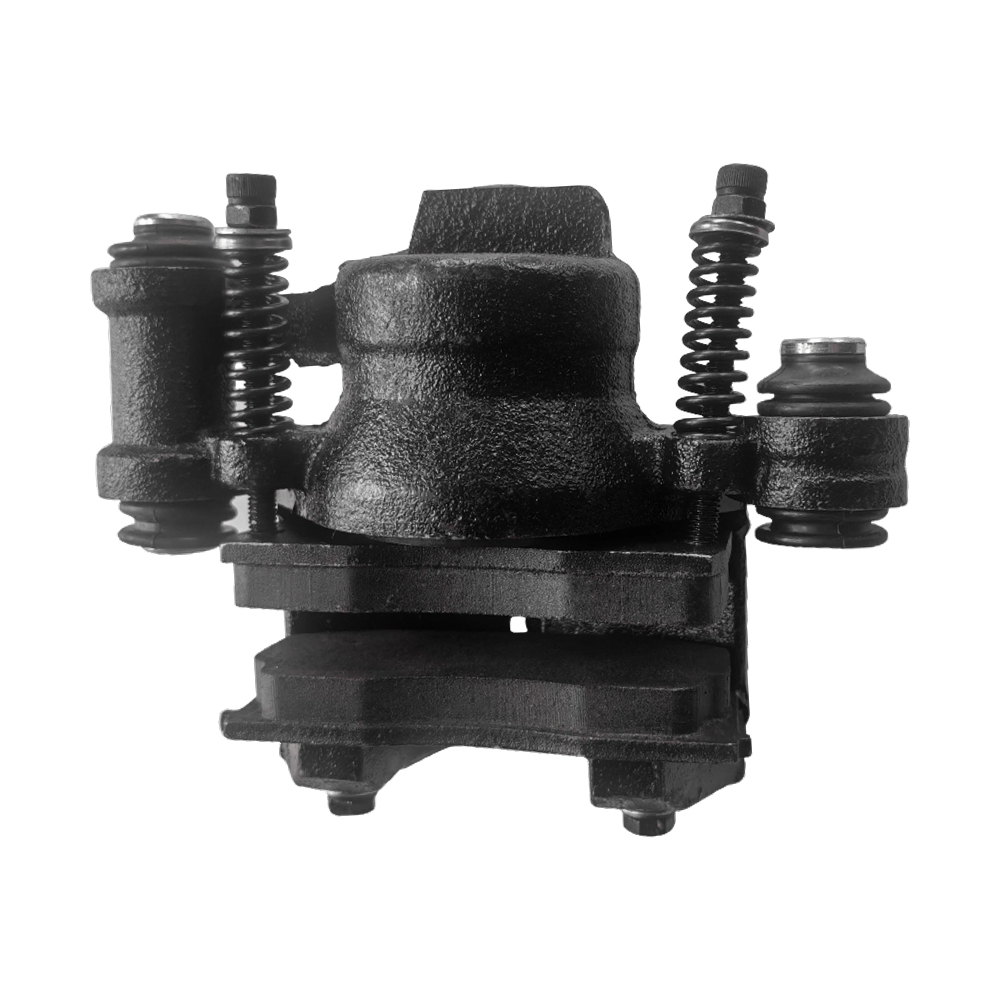
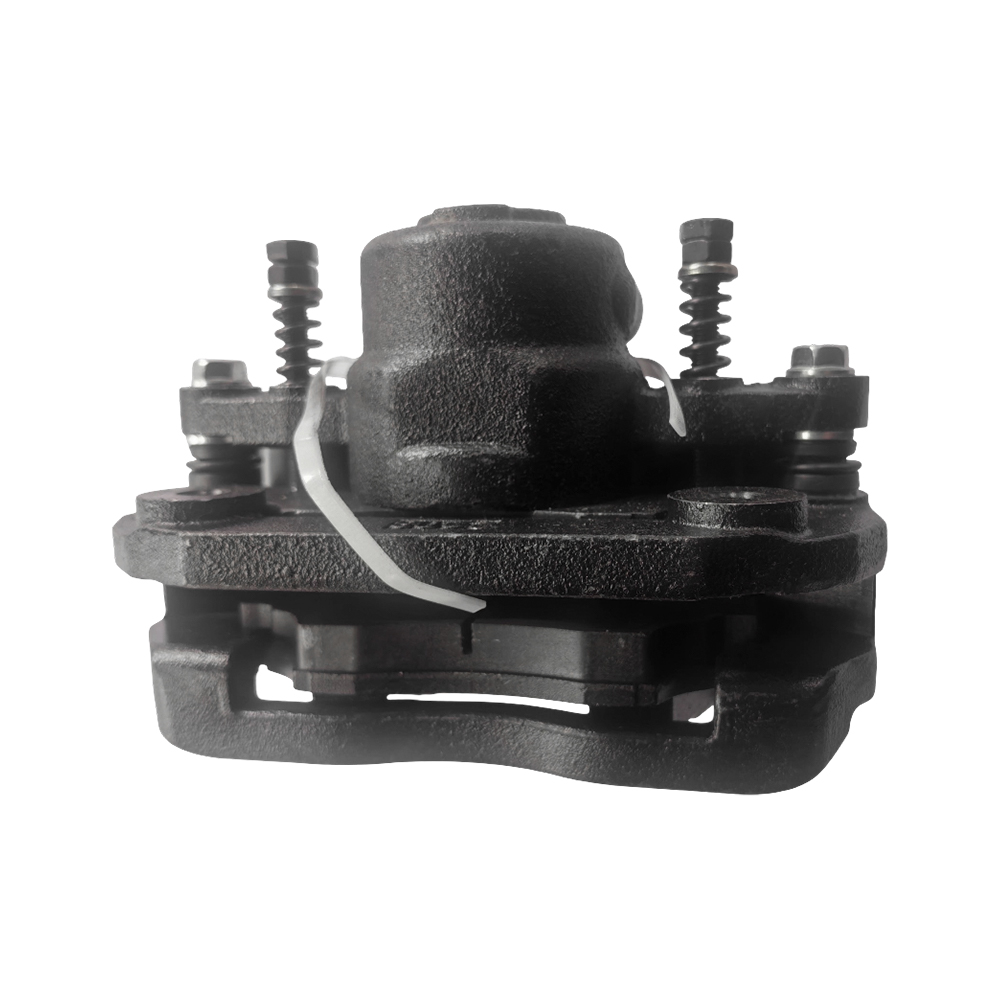
In a floating caliper, only one side has a piston. The caliper assembly slides on guide pins so the opposite pad is pulled into contact by the reaction force. In a fixed caliper, pistons are located on both sides and the caliper body is rigidly mounted. Fixed calipers are stiffer and provide more uniform pad wear, but they are larger and more expensive. For most construction machinery, floating calipers are preferred because they tolerate slight disc runout and dirt build-up better.
Safety consideration: In a properly sized caliper, the brake pump and pressure relief valve should deliver reliable pressure without overheating. If the pressure drops below the design value, the caliper can no longer generate sufficient clamping force, leading to extended stopping distance.
The same hydraulic pressure logic also drives how modern braking systems ensure safety, from pressure modulation to material selection. Modern braking system safety design uses redundant seals and proper caliper sizing to maintain consistent performance.
Three caliper configurations dominate construction machinery applications: floating calipers, fixed calipers, and spring-applied calipers. Each solves a different problem.
The dual-function driving and parking brake caliper combines service and parking functions in one compact unit. This reduces the number of components, saves axle space, and simplifies the hydraulic circuit. Anhui Zhongjia's dual-function caliper is designed for construction machinery that requires both dynamic braking and secure parking on slopes.
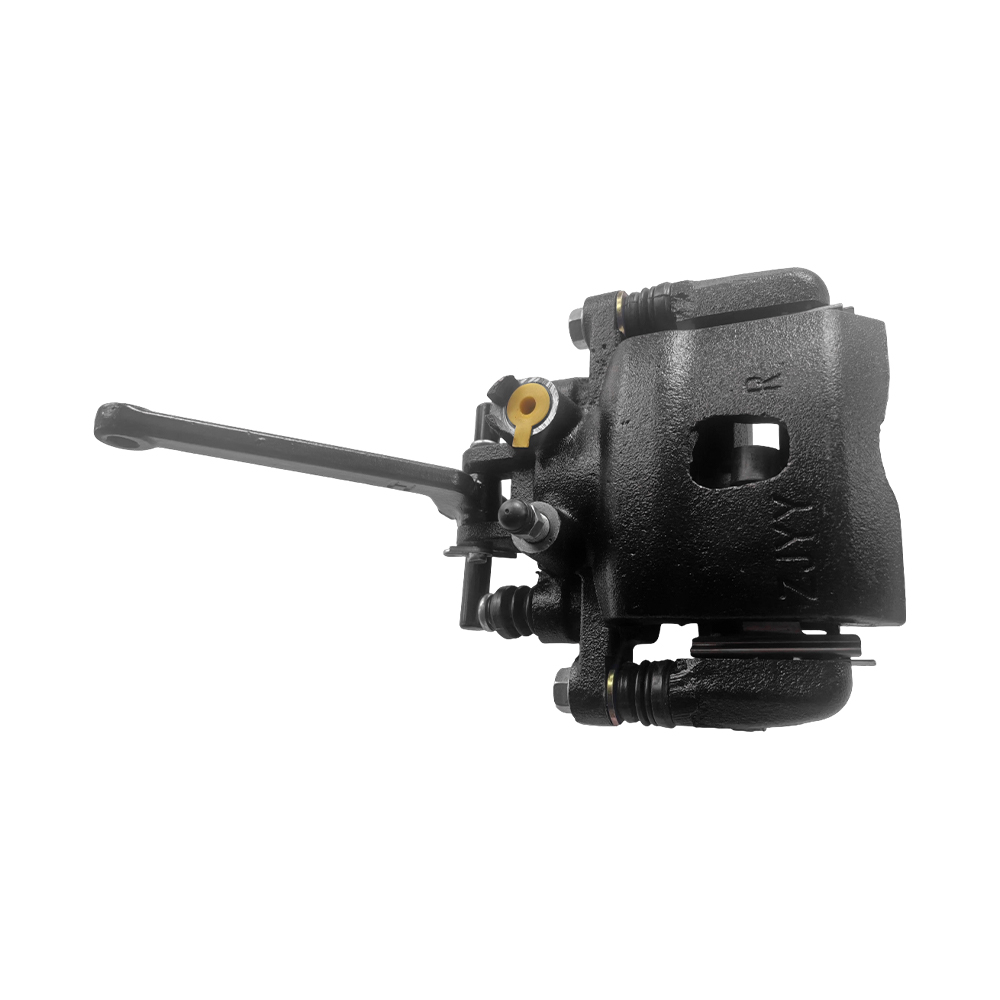
 Integrated Service and Parking Brake Caliper for Construction EquipmentCombining dynamic braking and spring-applied parking in one compact unit, this caliper saves axle space and simplifies hydraulic circuits. Ideal for loaders, tractors, and mining vehicles on slopes, it enhances safety with self-adjusting and anti-lock features.View Product →
Application note: For a 3-tonne excavator traveling on a 20 percent grade, a spring-applied caliper prevents the machine from rolling away when the engine is off. The same caliper can also be used as a dynamic brake in an integrated system.
Selecting a construction machinery brake caliper starts with calculating the total required braking torque, then checking whether the available hydraulic pressure and caliper piston area can deliver it. The braking torque equation is: torque = friction force x effective radius. The caliper must be sized to handle the maximum axle load, the machine's top travel speed, and the duty cycle. In addition, the caliper must fit within the rim or axle mounting envelope, tolerate ambient dust, and match the master cylinder output.
| Machine class | Axle load | Typical caliper type | Hydraulic pressure range |
|---|---|---|---|
| Mini excavator (2-6 t) | 2 t per axle | Floating, single-caliber | 10-14 MPa |
| Wheel loader (10-20 t) | 8 t per axle | Floating or fixed | 12-16 MPa |
| Rigid dump truck (40-60 t) | 25 t per axle | Fixed multi-piston | 14-20 MPa |
When specifying calipers, buyers from OEMs should also evaluate the supplier's ability to produce compatible seals, mounting brackets, brake pads and, if needed, a separate mechanical parking mechanism. Anhui Zhongjia Hydraulic Technology Co., Ltd. provides custom construction machinery brake calipers with different piston configurations and bore sizes.
Procurement tip: Ask the supplier for the caliper's rated holding force at the machine's minimum operating pressure. A caliper that meets the braking demand at 20 MPa may fail at 10 MPa in cold weather or after the hydraulic system warms up.
The most common construction machinery brake caliper failures are fluid leaks at the piston seal, piston seizure in the bore, uneven brake pad wear, and parking brake drift. Early detection prevents costly axle damage.
Maintenance interval: For machines in normal duty, inspect brake calipers at 500-hour intervals or every three months, whichever comes first. Machines in high-dust or high-slip applications should be inspected at 250 hours.
Quick answer: A construction machinery brake caliper is a hydraulic actuator that uses pressurized oil to clamp brake pads onto a rotor, generating the frictional force needed to stop a heavy machine.
Construction machinery calipers are designed for higher shock loads, more frequent cycling, and harsher environments. They typically use larger piston bores, thicker housings, and more robust seals than automotive calipers. Many also integrate a spring-applied parking brake function for fail-safe stopping.
Yes. A dual-function caliper combines hydraulic service braking with a spring-applied parking brake in the same housing. This saves space, reduces component count, and simplifies the hydraulic circuit on construction equipment.
In normal duty, inspect at 500-hour intervals or every three months. In dusty, muddy or high-slip environments, inspect at 250-hour intervals. Pay attention to fluid leaks, pad wear, and parking brake holding ability.
Typical service brake pressure ranges from 10-20 MPa, depending on the machine class and axle load. The caliper must be sized to produce adequate clamping force at the lowest expected system pressure, not just at the maximum.
Recommended Products

Contact Info.
+86-159 9623 5291
No. 5, Chuangye Road, Niandou Industrial Park, Ma'anshan City, Anhui Province, China
MOBILE QR CODE

 English
  Español