en

Need Help Now? Call Us!
+86-159 9623 5291

Our team proudly offers an on-time guarantee and a 100% customer satisfaction guarantee.
Contact Online


 Home / News / Industry News / Which Solenoid Directional Valve Configuration Optimizes Your Hydraulic System?
  2026.04.09
  Industry News
 Content
Engineers and procurement specialists face critical decisions when specifying solenoid directional valve components for hydraulic systems. These electromechanical devices convert electrical signals into mechanical spool movement, directing fluid flow through predetermined paths to control cylinder extension, motor rotation, or system isolation. Understanding spool configurations, voltage options, and pressure ratings ensures reliable system performance across industrial automation, mobile equipment, and process control applications.
A solenoid directional valve consists of a valve body containing a precision-machined spool, solenoid coils that generate electromagnetic force, and return springs that establish default positions. When energized, the solenoid coil creates a magnetic field that shifts the spool against spring resistance, opening and closing flow paths between the pressure, tank, and work ports. De-energization allows springs to return the spool to its neutral or default position.
Direct-acting valves utilize solenoid force alone to shift the spool, requiring no minimum hydraulic pressure for operation. These designs achieve response times within milliseconds and operate effectively at zero pressure. Pilot-operated configurations use solenoid-controlled pilot pressure to shift larger main stage spools, enabling control of high-flow rates with relatively small solenoid power consumption .
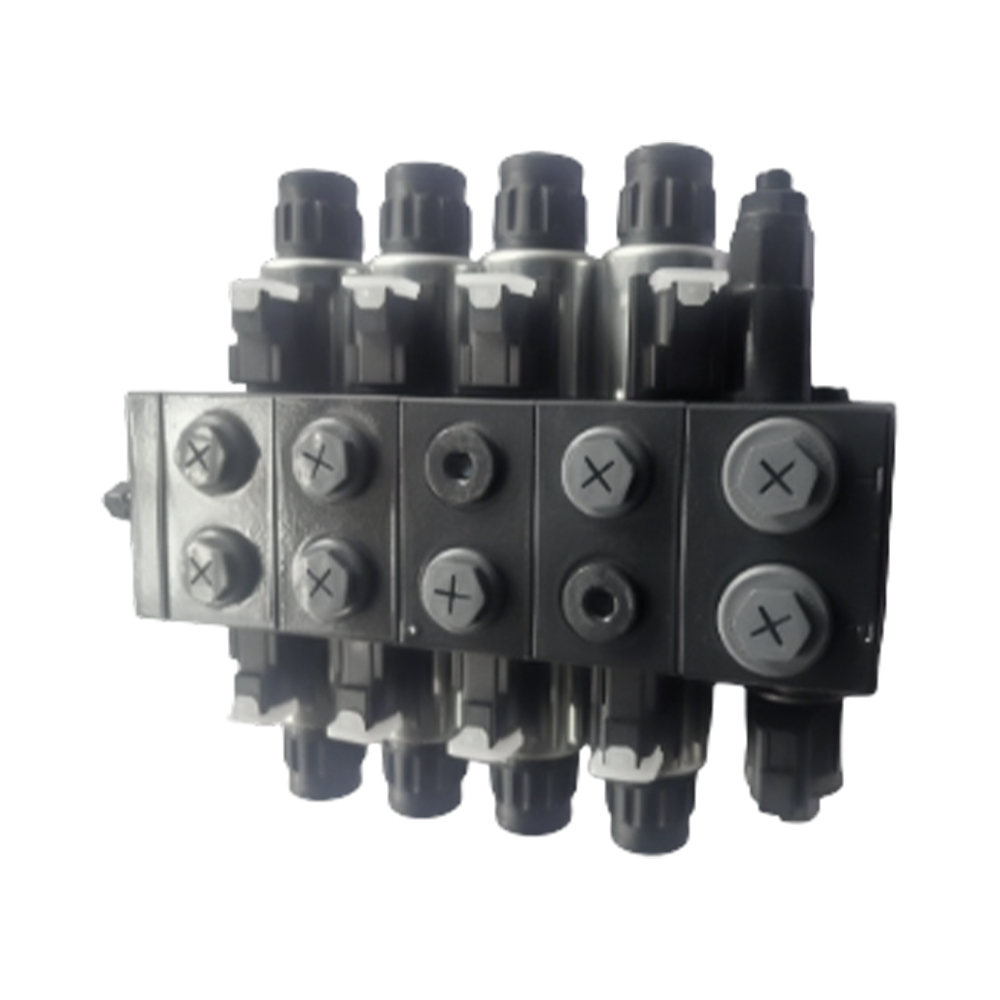
Spool geometry determines flow routing capability and neutral position characteristics. The first number indicates port count (pressure, tank, and work ports), while the second number indicates the discrete positions the spool can occupy. Engineers must match spool configuration to actuator requirements and safety considerations.
The following table compares common spool configurations:
| Configuration | Ports | Positions | Neutral State | Typical Application |
| 4/3 Way Center-Closed | 4 (P, T, A, B) | 3 | All ports blocked | Holding applications, load locking |
| 4/3 Way Center-Open | 4 (P, T, A, B) | 3 | P, T, A, B connected | Gravity lowering, pump unloading |
| 4/3 Way Float Center | 4 (P, T, A, B) | 3 | A, B to T, P blocked | Free-wheeling motor applications |
| 4/2 Way | 4 (P, T, A, B) | 2 | Spring return single position | Single-acting cylinders |
| 3/2 Way | 3 (P, T, A) | 2 | Normally closed/open | Clamping, pilot control |
4/3 way solenoid directional valve configurations with center-closed spools block all ports in the neutral position. This arrangement maintains actuator position by trapping fluid in cylinder chambers, preventing drift under load. Center-closed valves suit lifting applications, holding circuits, and systems requiring position maintenance when solenoids de-energize. The blocked-center design also enables pump pressure buildup for parallel circuit operation
Center-open spools connect all ports (pressure, tank, and both work ports) in the neutral position. This configuration unloads the pump to the tank at minimal pressure, reducing heat generation and energy consumption during idle periods. The work port connection to the tank allows gravity-induced cylinder movement for lowering operations. However, this design cannot hold loaded actuators in position without additional valving.
4/2 way valves provide two discrete positions without a defined neutral state, typically spring-returning to a default position when de-energized. These simpler configurations control single-acting cylinders or motor direction with minimal complexity. 3/2 way variants manage single-port control applications, including clamping circuits, pilot pressure supply, and selector functions.
Double-acting cylinder control typically requires 4/3 way configurations. Center-closed spools suit applications requiring load holding, while center-open spools benefit systems needing pump unloading or gravity lowering. Single-acting applications may utilize 4/2 or 3/2 way valves for simplified control and reduced cost. System safety requirements and failure-mode analysis should drive final spool selection.
Solenoid coil voltage selection impacts system compatibility, heat generation, and installation requirements. Standard industrial voltages include 12V DC, 24V DC, 110V AC, and 220V AC, with availability depending on regional electrical standards and application environment
The following comparison table outlines voltage characteristics:
| Voltage Option | Current Draw | Heat Generation | Cable Distance | Primary Applications |
| 12V DC | High (double 24V) | Warmer operation | Short runs preferred | Mobile, automotive, battery systems |
| 24V DC | Moderate | Cooler operation | Long distances acceptable | Industrial automation, PLCs |
| 110V AC | Low | Moderate | Standard industrial | North American industrial |
| 220V AC | Lowest | Moderate | Standard industrial | European, Asian industrial |
12V 24V solenoid directional valve options include 12V DC coils primarily for mobile equipment and battery-powered systems. Agricultural machinery, construction equipment, and automotive applications utilize 12V DC because vehicle electrical systems operate at this voltage. The higher current draw at 12V (approximately double that of 24V for equivalent power) generates more heat and limits cable run lengths due to voltage drop sensitivity .
24V DC represents the predominant voltage for industrial automation and stationary hydraulic systems. This voltage aligns with PLC control systems, safety relays, and industrial control cabinets. Lower current requirements compared to 12V reduce heat generation, enabling continuous duty operation with extended coil life. 24V systems tolerate longer cable runs with minimal voltage drop, supporting distributed valve installations .
AC solenoids (110V or 220V, depending on region) offer high force output and compatibility with standard industrial power. AC coils exhibit inrush current characteristics that provide a strong initial shifting force, followed by a lower holding current. However, AC solenoids produce audible hum from alternating magnetic fields and may generate more heat than DC equivalents during continuous operation. Modern valves often specify DC solenoids with rectifiers for AC applications.
Coil power ratings typically range from 20W to 35W for standard performance valves, with high-performance variants offering greater spool actuating force per watt expended. Continuous duty rating (100% duty cycle) indicates suitability for constant energization without overheating. Intermittent duty coils require cooling periods between actuation cycles. IP65 protection ratings ensure dust and water jet resistance, with IP67 and IP69K options available for harsh environments.
Operating limits define the safe envelope for the solenoid directional valve application. Exceeding rated pressure causes seal failure, spool binding, or structural damage. Insufficient flow capacity creates excessive pressure drop, generating heat and reducing system efficiency.
The following table presents typical performance specifications:
| Parameter | CETOP 3 (NG6) | CETOP 5 (NG10) | CETOP 7 (NG16) | CETOP 8 (NG25) |
| Max Operating Pressure (P, A, B) | 350 bar (5075 psi) | 350 bar | 350 bar | 315 bar |
| Max Tank Line Pressure | 160 bar | 160 bar | 160 bar | 160 bar |
| Nominal Flow Rate | 40-80 L/min | 120-160 L/min | 300 L/min | 650 L/min |
| Pressure Drop at Nominal Flow | 2-4 bar | 3-5 bar | 4-6 bar | 5-8 bar |
| Response Time (energize) | 20-40 ms | 30-50 ms | 40-60 ms | 50-80 ms |
Solenoid directional valve pressure rating specifications typically indicate 350 bar (5075 psi) maximum for pressure ports (P, A, B) in standard industrial valves. Tank port (T) ratings are lower, often 50-160 bar d, depending on design. Pilot-operated valves require minimum pilot pressure (typically 5-10 bar) for reliable spool shifting under load. System designers must verify that transient pressure spikes do not exceed rated limits, incorporating relief valves where necessary.
Flow ratings indicate the maximum recommended flow at an acceptable pressure drop. CETOP 3 valves handle 40-80 L/min depending on spool type and internal geometry. Larger CETOP 5 valves accommodate 120-160 L/min for higher power applications. Exceeding nominal flow increases pressure drop exponentially, generating heat and potentially causing cavitation. System designers should size valves at or below nominal flow for optimal efficiency.
Pressure drop across the valve represents energy loss converted to heat. Standard spools exhibit 2a -5 bar pressure drop at rated flow, while open-center spools may show lower resistance. Fine-control spools with metering notches increase pressure drop for improved flow modulation. Accumulated pressure drops across multiple valves in series circuits require careful analysis to ensure adequate system pressure at actuators.
Standardized mounting interfaces ensure interchangeability between manufacturers and simplify system design. The predominant standard for industrial valves is CETOP (Comité Européen des Transmissions Oléohydrauliques et Pneumatiques), harmonized with ISO 4401
The following table compares mounting standards:
| Standard Designation | Nominal Size | Port Pattern | Bolt Spacing | Typical Flow Range |
| CETOP 3 / ISO 4401-03 | NG6 | 4 ports, 6mm bolts | 42mm × 42mm | 40-80 L/min |
| CETOP 5 / ISO 4401-05 | NG10 | 4 ports, 8mm bolts | 56mm × 56mm | 120-160 L/min |
| CETOP 7 / ISO 4401-07 | NG16 | 4 ports, 10mm bolts | 80mm × 80mm | 250-300 L/min |
| CETOP 8 / ISO 4401-08 | NG25 | 4 ports, 12mm bolts | 100mm × 100mm | 500-650 L/min |
| NFPA D03 | Equivalent NG6 | Similar to CETOP 3 | 1.75" × 1.75" | 40-80 L/min |
| NFPA D05 | Equivalent NG10 | Similar to CETOP 5 | 2.22" × 2.22" | 120-160 L/min |
CETOP 3 solenoid directional valve specifications represent the most common industrial size, offering compact dimensions with substantial flow capability. The standardized port pattern includes P (pressure), T (tank), A, and B (work) ports arranged for subplate mounting. Threaded port options include BSPP (G-thread), NPT, or metric d, depending on regional preferences. Subplates provide mounting surfaces and port threading, enabling valve replacement without disturbing plumbing
North American markets utilize NFPA (National Fluid Power Association) standards dimensionally equivalent to CETOP specifications. D03 corresponds to CETOP 3/NG6, while D05 matches CETOP 5/NG10. While port patterns and bolt spacing are similar, minor dimensional differences may affect exact interchangeability. Engineers should verify mounting hole patterns and port locations when mixing standards.
Subplates adapt valve mounting faces to system plumbing. Side-ported subplates route connections horizontally, while bottom-ported versions direct flow vertically for manifold installations. Sandwich plates are installed between the subplate and the valve, providing additional functions such as pressure relief, flow control, or check valves without separate components. Modular stacking systems enable complex circuit arrangements in minimal space.
Standard directional valves provide discrete on/off control, while proportional solenoid valve technology enables infinite spool positioning for variable flow control. Understanding this distinction ensures appropriate technology selection for application requirements
The following comparison table differentiates valve types:
| Characteristic | Directional Control Valve | Proportional Valve |
| Control Type | On/Off switching | Continuous variable |
| Spool Position | 2 or 3 discrete positions | Infinite positions within range |
| Electrical Input | Digital on/off | Analog 0-10V or 4-20mA |
| Flow Control | Full flow or zero | 0-100% variable |
| Pressure Control | System pressure only | Variable pressure limiting |
| Cost | Lower | Higher (electronics) |
| Complexity | Simpler | More complex |
| Typical Applications | Clamping, lifting, positioning | Speed control, acceleration, deceleration |
Standard solenoid directional valve configurations shift between discrete positions, providing full flow when energized and blocking flow when de-energized (or reversing flow depending on spool type). This binary control suits applications requiring simple cylinder extension/retraction or motor direction change without intermediate speed requirements. The simpler design offers lower cost and higher reliability for basic automation tasks .
Proportional valves utilize variable solenoid force controlled by analog electrical signals to position the spool anywhere between fully closed and fully open. This capability enables smooth acceleration, precise speed control, and programmable motion profiles. Input signals typically range from 0-10V DC or 4-20mA, with spool position feedback options for closed-loop control. Applications requiring synchronized motion, soft starting, or variable speed operation benefit from proportional technology.
Simple on/off applications with fixed speed requirements suit standard directional valves at la ower cost. Applications requiring variable speed, smooth motion, or precise positioning justify proportional valve investment. Some systems combine both technologies—proportional valves for main motion control and directional valves for auxiliary functions. System complexity, performance requirements, and budget constraints drive final selection.
Proper valve specification requires determination of maximum operating pressure, required flow rate, actuator type, and control precision. Calculate system flow demands based on cylinder bore sizes and required extension speeds. Verify pressure requirements, including static loads and dynamic resistance. Define control needs—simple on/off or variable positioning—and specify voltage compatibility with existing control infrastructure.
Operating environment influences seal material selection and enclosure ratings. Standard nitrile (Buna-N) seals suit petroleum-based hydraulic oils from -20°C to 80°C. Fluorocarbon (Viton) seals accommodate higher temperatures to 100°C and synthetic fluids. EPDM seals are required for phosphate ester fluids but are incompatible with petroleum oils. IP65 ratings protect against dust and water jets, while IP67 and IP69K ratings withstand submersion and high-pressure washdown.
Proper electrical installation ensures reliable operation and coil longevity. Verify voltage matches coil specifications exactly—24V valves fail to operate on 12V supplies, while overvoltage causes rapid coil overheating. Incorporate surge protection to prevent voltage spike damage. DIN 43650 connectors provide standard three-pin connections with ground pins for safety. Centralized connectors enable multiple valve control through single cable harnesses
Valve failure modes include coil burnout, spool sticking, and internal leakage. Coil failure typically results from overvoltage, undervoltage, or excessive duty cycle. Spool sticking indicates contamination, scoring, or insufficient pilot pressure. Internal leakage past the spool indicates wear or damage requiring replacement. Regular fluid filtration maintenance extends valve service life significantly—systems should maintain ISO 4406 cleanliness codes appropriate for valve clearances.
A 4/3 way valve provides three distinct spool positions with four ports (pressure, tank, and two work ports), typically including a neutral center position. This configuration allows the actuator to stop and hold position when the valve is de-energized. A 4/2 way valve offers only two positions, usually spring-returning to a default state when de-energized. The 4/3 way valve suits double-acting cylinder applications requiring mid-position stopping, while 4/2 way valves are simpler and less expensive for single-acting or continuous motion applications. Center-closed 4/3 valves trap fluid for load holding, while center-open variants unload the pump
Choose 12V DC for mobile equipment, automotive applications, or battery-powered systems where the electrical infrastructure already operates at 12V. Select 24V DC for industrial automation, PLC-controlled systems, and stationary equipment where 24V is the control standard. 24V offers lower current draw, reduced heat generation, and better tolerance for long cable runs. AC solenoids (110V or 220V) suit applications with standard industrial power available and where high solenoid force is required. For new industrial installations, 24V DC is generally preferred for compatibility with modern control systems and improved safety.
Specify valves rated for at least 350 bar (5075 psi) maximum operating pressure for P, A, and B ports to provide a safety margin above your 300 bar system pressure. Verify the tank port (T) rating meets your return line requirements—typically 160 bar or lower is sufficient for most applications. Consider pilot-operated valves for high-flow requirements above 80 L/min, as direct-acting valves may struggle to shift against full system pressure. Ensure the valve's fatigue rating matches your application—continuous-duty industrial valves are tested for 20 million cycles or more. Always incorporate system relief valves set below valve maximum ratings to protect against pressure spikes.
Specify proportional valves when your application requires variable speed control, smooth acceleration/deceleration, or precise positioning rather than simple on/off operation. Proportional valves enable infinite spool positioning through analog control signals (0-10V or 4-20mA), providing flow rates from 0-100% of capacity. Applications benefiting from proportional control include crane boom positioning, conveyor speed regulation, injection molding machine clamping, and any system requiring synchronized multi-axis motion. Standard directional valves suffice for clamping, lifting, and simple cylinder extension/retraction at fixed speeds. Proportional valves cost more due to sophisticated electronics and feedback mechanisms, but provide superior control for demanding applications

Contact Info.
+86-159 9623 5291
No. 5, Chuangye Road, Niandou Industrial Park, Ma'anshan City, Anhui Province, China
MOBILE QR CODE

 English
  Español