en

Need Help Now? Call Us!
+86-159 9623 5291

Our team proudly offers an on-time guarantee and a 100% customer satisfaction guarantee.
Contact Online


 Home / News / Industry News / What are the material requirements for electromagnetic multi-way valves?
  2025.09.30
  Industry News
 The material selection for an electromagnetic multi-way valve directly affects its pressure resistance, wear resistance, corrosion resistance, and service life. It requires comprehensive consideration of factors such as operating pressure, media characteristics, and environmental conditions.
The following are key material selection requirements and typical application solutions: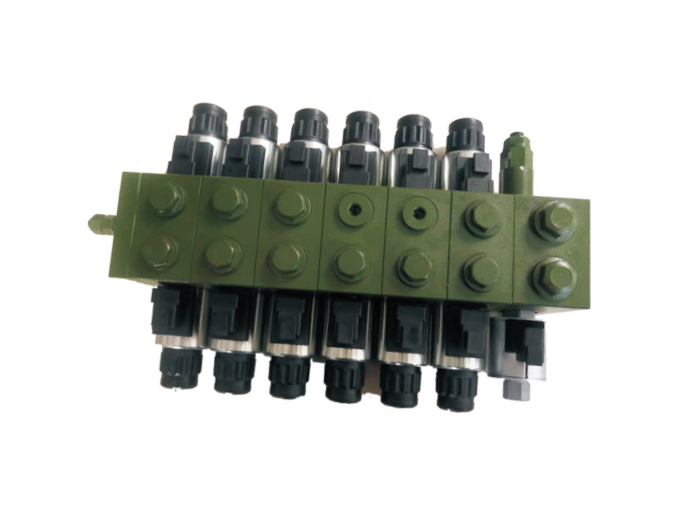
I. Core Component Material Requirements
1. Valve Body Material
Material Type | Characteristics | Applicable Scenarios
Ductile Cast Iron (QT500-7) | High strength (tensile strength ≥500MPa), good vibration damping, low cost | Medium and low pressure systems (≤35MPa), engineering machinery
Forged Steel (42CrMo) | Ultra-high strength (tensile strength ≥1000MPa), fatigue resistant, heat-treated and tempered | High pressure systems (42MPa+), metallurgical equipment
Aluminum Alloy (6061-T6) | Lightweight (density 2.7g/cm³), corrosion resistant, but lower pressure resistance (≤21MPa) | Aviation, mobile equipment
Stainless Steel (316L) | Resistant to acid and alkali/seawater corrosion, but high cost | Chemical industry, offshore platforms
Special Treatment:
Inner wall finishing: Ra≤0.4μm, reducing flow resistance.
Coating reinforcement: The valve body cavity is coated with a WC-Co coating (hardness HV1200+), resistant to particle erosion.
2. Valve Core and Sleeve
Material Combination | Advantages | Technical Parameters
20CrMnTi Carburized and Quenched + Hard Chrome Plating | Surface Hardness HRC60-62, Wear Resistance | Plating Thickness ≥0.03mm, Lifespan ≥1 million cycles
Stainless Steel (440C) + PTFE Coating | Corrosion Resistant and Low Coefficient of Friction (μ≤0.05) | Suitable for water-glycol media
Ceramic (Al₂O₃/ZrO₂) | Ultra-wear Resistant, Anti-adhesion, but Brittle | Used for high-pressure (≥60MPa) extreme working conditions
Precision Fit:
Valve Core and Valve Orifice Gap Control:
Ordinary Valve: 0.01~0.03mm
High-Precision Valve: ≤0.005mm (Requires temperature-controlled assembly)
3. Seals
Material | Temperature Range | Media Resistance | Lifespan
Nitrile Rubber (NBR) | -30℃~100℃ Mineral oil, water-oil emulsion: 500,000 cycles
Fluororubber (FKM): -20℃~200℃, acids and alkalis, synthetic ester oils: 1 million cycles
Polyurethane (PU): -40℃~80℃, high wear resistance, but not hydrolysis resistant: 300,000 cycles
PTFE + metal skeleton: -100℃~260℃, all hydraulic oils, highly corrosive media: 2 million cycles
II. Material Selection Strategy Based on Working Conditions
1. High-Pressure, Heavy-Duty Working Conditions (e.g., tunnel boring machines)
Valve Body: 42CrMo forged steel (quenched and tempered HB280-320)
Valve Core: 20CrMnTi carburized and quenched + laser-clad Stellite alloy
Seal: FKM + PTFE composite seal
2. 3. Corrosive Environments (e.g., Chemical Equipment)
Valve Body: 316L Stainless Steel (Passivated)
Valve Core: 17-4PH Precipitation Hardened Stainless Steel
Sealing: PTFE Full-Encapsulation Structure
4. Low-Temperature Environments (e.g., Ground Machinery)
Valve Body: QT400-18L (Low-Temperature Ductile Iron, -60℃ Impact Energy ≥12J)
Sealing: Silicone Rubber (MVQ) or Hydrogenated Nitrile Butadiene Rubber (HNBR)
5. Food/Pharmaceutical Equipment
Valve Body: 304 Stainless Steel (Electropolished Ra≤0.2μm)
Sealing: FDA-Certified EPDM Rubber
III. Application of Special Functional Materials
Antistatic Requirements:
Valve core with added carbon fiber (volume resistivity ≤10⁶Ω·cm) to prevent sparks from igniting dust.
Weight Reduction Design:
Titanium alloy (TC4) valve body, with the same strength as steel but 40% lighter.
Ultra-long lifespan:
The valve core uses a diamond-like carbon (DLC) coating, with a friction coefficient <0.02.
IV. Common Material Failures and Countermeasures
Failure Mode | Cause | Solution
Valve core scoring | Hard particles intruding into the gap | Replace with WC-Co coated valve sleeve + online filter
Seal swelling | Oil and material incompatibility | Replace with FKM or PTFE material
Valve body cracking | Casting defects or pressure shock | Use forged steel valve body + finite element stress optimization design
V. Future Material Trends
Smart materials: Shape memory alloy valve core, temperature-adaptive flow regulation.
Nanocomposite materials: Graphene-reinforced valve body, strength increased by 50%.
3D printing: Topology-optimized structure + gradient materials (e.g., copper-steel composite cooling channels).
Selection recommendation: A comprehensive evaluation is required, considering factors such as cost (materials account for 30%~50% of the total valve body cost), operating conditions, and maintenance cycle. Prioritize material options that are certified to ISO 4400/DIN 24340.
Recommended Products

Contact Info.
+86-159 9623 5291
No. 5, Chuangye Road, Niandou Industrial Park, Ma'anshan City, Anhui Province, China
MOBILE QR CODE

 English
  Español