en

Need Help Now? Call Us!
+86-159 9623 5291

Our team proudly offers an on-time guarantee and a 100% customer satisfaction guarantee.
Contact Online


 2025.04.25
  Company News
 The installation quality of electromagnetic multi-way valves directly affects the stability, response speed, and service life of hydraulic systems. The following are key details that require strict control during installation, covering preliminary preparation, installation steps, commissioning points, and troubleshooting common problems: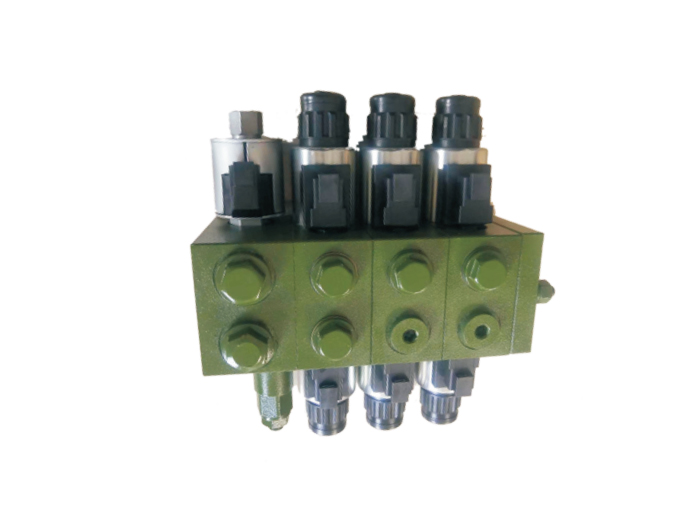
I. Pre-installation Preparations
**Verify Valve Parameters**
Confirm that the valve model, nominal diameter, working pressure (rated pressure/peak pressure), and flow rate match the system.
Check that the solenoid valve voltage (AC/DC) and current are consistent with the control system to avoid burning out the coil.
Confirm that the valve's functions (neutral position function, number of spools) meet design requirements (e.g., O-type, Y-type, P-type, etc.).
**Clean Piping and Oil**
Use high-pressure gas or specialized flushing equipment to remove welding slag, iron filings, and other impurities from the pipes (a cleanliness level of NAS 1638 Class 7 or higher is recommended).
New oil must be filtered (5~10μm filter element) to prevent particulate matter from clogging the valve core.
**Inspect Seals**
Check that the O-ring and gasket materials (e.g., NBR, FKM) are compatible with the hydraulic oil (mineral oil/water-glycol, etc.).
Apply a small amount of hydraulic oil to the seals before installation to prevent tearing.
II. Key Details During Installation
Valve Body Fixing and Connection
Mounting Surface Flatness: The roughness of the mounting surface of the valve block or base plate must be ≤Ra 0.8μm, and the flatness ≤0.01mm/100mm to avoid leakage or valve body deformation.
Bolt Tightening Sequence: Tighten in stages along the diagonal (e.g., increasing torque in 2-3 stages), referring to the torque values provided by the manufacturer (overtightening will cause valve body deformation).
Oil Port Alignment: Ensure the inlet and outlet are aligned with the pipeline; do not forcibly pull the pipeline connection.
Solenoid Valve Wiring
Use shielded cables to reduce interference; ensure the terminals are securely crimped.
Coil voltage fluctuation range should be controlled within ±10% (e.g., 21.6~26.4V for a 24V DC system).
If the valve assembly has pilot control, the pilot oil circuit pressure must be checked separately (usually 0.3~0.5MPa).
Oil Drain Port Treatment
A separate oil drain port (if applicable) must return directly to the oil tank, and the pipeline must be free of back pressure; otherwise, the valve core may fail to reset.
The oil drain pipe should ideally be lower than the valve body installation position to avoid siphoning.
III. Debugging and Verification
No-Load Test
First, briefly start the motor and observe whether the oil pump rotation is correct to eliminate air intake into the system.
Manually push the valve core (if a mechanical emergency device is available) to check whether the actuator operates smoothly.
Power-On Test
Power on each circuit sequentially and listen for a crisp sound when the solenoid valve switches (a dull sound indicates jamming).
Measure the coil temperature rise; a temperature rise ≤40℃ after 1 hour of continuous operation is normal.
Load Test
Gradually increase the system pressure to the rated value and check for leaks at all valve body interfaces.
Verify the switching response time (usually ≤0.1s) and repeatability.
IV. Common Problems and Solutions
Problem | Possible Cause | Solution
Valve spool doesn't switch direction | Solenoid coil burnout/insufficient voltage | Replace coil, check power supply stability
Large internal leakage | Valve spool wear/contamination and jamming | Disassemble, clean, or replace valve spool
System vibration and noise | Pipeline resonance/hydraulic shock | Add accumulator or adjust damping orifice
Switching delay | Oil viscosity too high/insufficient pilot pressure | Replace with appropriate oil or adjust pilot pressure
V. Maintenance Recommendations
Regular inspection: Check valve body bolt torque and sealing condition every 500 hours.
Contamination control: Replace filter element every 2000 hours; maintain oil cleanliness at ISO 4406 18/16/13 level.
Spare parts inventory: Prioritize stockpiling solenoid coils and seals to minimize downtime.
Tip: For complex multi-way valves (such as proportional valves, load-sensitive valves), it is recommended to use the manufacturer's commissioning software for parameter calibration. If the system malfunctions frequently, it is necessary to check whether the valve performance is reduced due to excessively high oil temperature (>65℃) or oil oxidation.

Contact Info.
+86-159 9623 5291
No. 5, Chuangye Road, Niandou Industrial Park, Ma'anshan City, Anhui Province, China
MOBILE QR CODE

 English
  Español